3D Celestial Starry Galaxy: Practical Digital Backgrounds for Creative Workflows
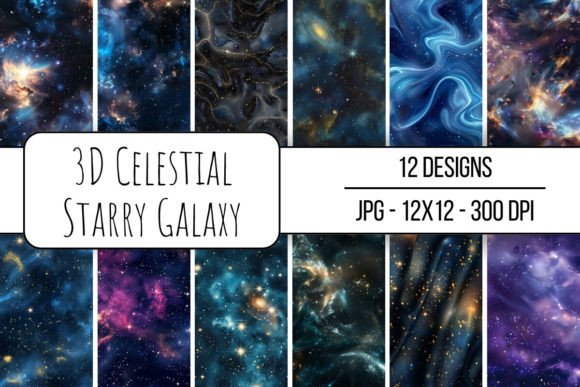
Digital assets that combine visual appeal with real utility are rare. Many stock background collections look impressive on the surface but fail to hold up when you need consistent quality across multiple projects. 3D Celestial Starry Galaxy is a set of twelve high-resolution digital backgrounds designed to bridge that gap. Whether you are a graphic designer preparing product mockups, a small business owner building brand assets, or a hobbyist working on printable designs, this collection offers a practical foundation for a wide range of creative tasks.
Each image in the set is rendered at 12 x 12 inches with 300 DPI, ensuring sharp output for both digital and print applications. The JPG format keeps file sizes manageable while preserving color depth, and the absence of watermarks means you can use them immediately without cleanup. Because this is a digital download, you get instant access to separate, labeled image files inside a single zip archive—ready to drop into your workflow within seconds of purchase.
Where This Collection Fits in a Creative Process
Understanding where a resource like 3D Celestial Starry Galaxy belongs in your broader workflow helps you use it more effectively. These backgrounds are not project-specific templates but versatile base layers that can serve different roles at different stages of your work.
Before a Project: Planning and Mood Setting
When you are in the early phases of a design or branding initiative, you often need visual references to establish direction. The celestial and galaxy motifs in this set provide a ready-made mood board. You can pull one or more backgrounds into a folder, present them to a client or team member, and use them as conversation starters about color palette, texture, and overall atmosphere. Because the collection includes twelve distinct variations, you have enough range to explore different directions without overwhelming yourself with options.
During a Project: Direct Integration into Assets
The most straightforward use of these backgrounds is as actual design elements. Because they are high-resolution JPGs at 300 DPI, you can place them directly into software like Photoshop, Illustrator, Affinity, Canva, or Procreate. They work as:
- Product mockup backgrounds for t-shirts, phone cases, mugs, and homeware
- Website and banner backdrops that add depth without distracting from foreground content
- Social media graphics where a consistent cosmic theme ties a campaign together
- Stationery and planner pages where a subtle or dramatic galaxy effect sets the tone
The key advantage during this phase is time saved. Instead of building a complex starry background from scratch—adjusting lighting, layering textures, and tweaking colors—you have a finished asset ready to composite. The 12 x 12 inch canvas gives you plenty of room to crop, scale, or rotate without losing quality.
After a Project: Archiving and Repurposing
Once a project is finished, these backgrounds do not become obsolete. Because they are generic enough to fit many contexts but distinctive enough to create a recognizable look, you can archive them as part of a reusable asset library. The labeled file names make it easy to find the right background months later when you need a similar cosmic feel for a new client or product line. This reduces the friction of starting from zero each time.
Integration with Tools, Platforms, and Other Assets
No digital resource exists in isolation. How well 3D Celestial Starry Galaxy interacts with your existing toolkit significantly affects its practical value.
Design Software Compatibility
JPG format is universally supported. You can import these images into any raster or vector application that accepts standard image files. For vector-heavy workflows like Cricut Design Space or Silhouette Studio, you can place a JPG as a base layer and trace or overlay cut paths on top. The 300 DPI resolution ensures that even after scaling down, the image remains crisp. If you work in print, the DPI meets the common minimum requirement for commercial printing, so you can send files directly to production without upsampling.
Print on Demand (POD) Workflows
For POD products—t-shirts, phone cases, homeware, and similar items—these backgrounds serve as both backdrop and primary design element. You can use a galaxy image as the full print for a fabric or case, or you can overlay text, logos, or illustrations. Because the collection offers twelve variations, you can test which background resonates best with your audience without needing to commission custom artwork. The labeled files also help you stay organized when you have multiple product variants.
Branding and Social Media
Cohesive branding across a website, shop banner, and social media channels requires a consistent visual language. The galactic theme of this set gives you a ready-made aesthetic that can unify disparate platforms. Use one background as your website hero section, a cropped version for your Instagram profile frame, and a different variation for your YouTube channel banner. The twelve images provide enough variety to keep content fresh while maintaining a recognizable brand thread.
Physical and Hybrid Projects
If you work with physical crafting tools like Cricut or Silhouette, these backgrounds can be printed on sticker paper, cardstock, or fabric and then cut into shapes. Because the files are named and separate, you can import them directly into your cutting software and set cut lines around specific elements. The 12 x 12 inch size matches many standard cutting mats, reducing the need to resize or tile.
Practical Implementation Tips
Getting the most out of a digital asset collection often comes down to small operational decisions. Here are observations that can help you integrate 3D Celestial Starry Galaxy smoothly into your routine.
Preparation Before Download
The zip file contains twelve separate JPG files. Before you unzip, ensure you have adequate storage space and a clear folder structure. Create a dedicated directory for celestial backgrounds with subfolders for raw files, edited versions, and project-specific crops. This upfront organization saves time when you need to locate a specific image later. The files are already named, but you may want to rename them with project codes or dates if you manage multiple client accounts.
Resizing and Resolution Management
Although 12 x 12 inches at 300 DPI is generous, you may need different aspect ratios for specific platforms (for example, 16:9 for YouTube or 1:1 for Instagram). Rather than stretching the original image, use a non-destructive workflow: place the JPG into your design software, crop to your target ratio, and export at the required resolution. Because the source is high quality, even a 50% crop will still yield a usable image for most digital and small-format print applications. If you need to enlarge beyond 12 x 12 inches, consider using a dedicated upscaling tool or plugin to maintain sharpness.
Color Consistency Across Projects
The galaxy backgrounds feature a colorful design with deep blues, purples, and starfield highlights. Different printers and screens may interpret these colors slightly differently. Run a test print on your target material before committing to a large batch. If you are designing for POD platforms, upload a test file and order a sample to verify that the celestial tones appear as intended. In digital environments, calibrate your monitor or use a color profile that matches the output medium.
Layering and Compositing
These backgrounds work well as base layers, but they can also be blended with other textures for more complex results. In Photoshop or similar software, try using the JPG as a layer set to Multiply, Overlay, or Screen blend mode over another image. This can produce unique effects without destroying the original file. Because the backgrounds are watermarked and clean, you can stack multiple variations to create depth—for example, combining a darker galaxy with a lighter starfield layer.
For E-Commerce Entrepreneurs and POD Sellers
You are launching a line of celestial-themed phone cases and t-shirts. Download the zip, extract all twelve files, and import them into your POD platform's design tool. For each product variant, assign a different background. Use the darkest images for phone cases (where contrast against a device silhouette matters) and the brighter ones for t-shirts (where fabric absorption may mute colors slightly). Label each product listing with the corresponding file name so you can track which background performs best in sales data.
For Graphic Designers and Freelancers
A client needs a series of social media posts for a cosmic-themed campaign. Start by placing one background as the base for each post variation. Overlay the client's logo, a short headline, and a call-to-action button. Because the backgrounds are already rich in detail, you can keep the typography minimal and let the galaxy imagery do the work. Export all posts at the required social media sizes, and archive the source files in the client's project folder with clear naming conventions.
For Educators and Content Creators
You are creating presentation slides or video thumbnails for a lesson on astronomy or space exploration. These backgrounds provide an immediate, accurate visual context. Import the JPGs into your presentation software (Google Slides, PowerPoint, Keynote) and use them as slide backgrounds. Adjust the brightness or contrast if text readability is a concern. For video thumbnails, crop a section of a galaxy image and overlay your title text using bold, contrasting colors.
For Hobbyists and Crafters
You design printable planners, notebooks, or wall art. Open the JPG in your preferred layout program, add grid lines or calendar templates on top, and export as a new PDF for print. For wall art, you may choose to use the background as-is without any added elements, framed in a simple black or gold border. Because the images are 12 x 12 inches, they fit well into square frames or can be trimmed to standard sizes like 8 x 10 or 11 x 14.
Quality Control and Long-Term Use
Consistency across repeated use is a hallmark of a well-curated asset library. With 3D Celestial Starry Galaxy, the twelve images share a common visual language, which means you can mix and match them within the same project without jarring style shifts. However, it is wise to keep a few considerations in mind for sustained use.
- Backup your files. Since this is a digital download, store the zip archive and the extracted files in at least two locations (local drive and cloud storage). Labels and folder names make retrieval painless.
- Document your edits. If you modify a background—cropping, changing colors, adding overlays—save a copy of the edited version with a clear suffix. This prevents accidental overwriting of the original.
- Test before scaling. While 300 DPI covers most print needs, extremely large formats (over 24 inches) may require upscaling. Always test a small section first.
- License awareness. Confirm that your intended use (commercial or personal) is covered by the license provided with the download. Most digital background sets allow commercial use, but double-check specifics for resale or redistribution.
Making the Most of the Collection
The value of a digital asset set lies not in its novelty but in its applicability to real tasks. 3D Celestial Starry Galaxy delivers twelve HD images that are ready to use out of the box, with minimal friction. The instant download, labeled files, and high-resolution format eliminate common bottlenecks: you do not need to wait for shipping, strip watermarks, or guess which file is which. The colorful, cosmic design provides a distinctive look that can elevate everything from a simple t-shirt mockup to a full brand identity.
Whether you are preparing a product launch, building a cohesive social media presence, designing stationery for a small shop, or experimenting with new crafting techniques, these backgrounds offer a reliable foundation. Integrate them into your workflow at the planning stage, use them as active design elements during execution, and archive them for future reuse. The more you treat them as a versatile resource rather than a one-off purchase, the more they will contribute to your creative efficiency and output quality.