Black and White Shapes: A Practical Digital Design Resource for Creators
When building a visual project, the smallest elements often determine whether the final result feels cohesive or disjointed. Designers, marketers, and content creators routinely search for assets that offer both flexibility and consistency without demanding extensive editing time. Black and White Shapes delivers exactly that: a curated set of six high-resolution digital papers built around monochromatic geometry and organic forms. This article examines what makes this collection worth your attention, where it performs best, and how it fits into realistic creative workflows.
What the Collection Offers
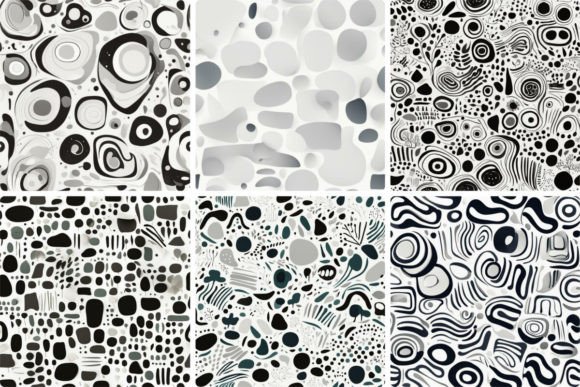
The package includes six digital papers delivered as individual JPG files. Each file measures 3000 by 3000 pixels at 300 DPI, which translates to a 10-inch square print at full resolution. This specification alone makes it suitable for both screen-based projects and physical output. The JPG format ensures broad compatibility across design software, operating systems, and devices. No proprietary formats, no plugin requirements, and no complex licensing hurdles.
The defining characteristic of this set is its monochrome palette combined with varied shape compositions. Some papers lean toward geometric precision—concentric circles, intersecting lines, repeating polygons—while others incorporate softer, more organic silhouettes. The contrast between dense pattern areas and negative space gives each sheet a distinct visual rhythm. For a designer working on branding materials or editorial layouts, this range provides enough variety to avoid monotony while maintaining a unified black-and-white aesthetic.
Resolution, Format, and Print Readiness
One of the first questions a professional should ask about any digital paper set is whether the resolution matches intended use cases. At 3000 pixels per side with 300 DPI, this collection sits comfortably above the minimum threshold for high-quality print reproduction. A standard greeting card typically measures 5 by 7 inches. With these files, you can print at that size and still retain substantial cropping room. For phone cases, which often require precise fitting around camera modules and buttons, the extra pixels allow you to scale without introducing blur or pixelation.
On the digital side, 3000px renders well on most displays as a wallpaper or background element. Even on large monitors, the files maintain crisp edges and clean contrast. The JPG compression is well balanced: file sizes are manageable for quick downloads and storage, yet the images retain enough detail that subtle shape transitions remain visible. For users accustomed to working with PNG files that preserve transparency, it is worth noting that these papers come as opaque JPGs. That is a practical tradeoff in exchange for smaller file sizes and faster workflow performance.
Strengths in Real-World Use
Black and White Shapes excels in projects where strong contrast and graphic impact are desired. The absence of color forces the viewer to focus on form, texture, and composition. This is particularly valuable for small business owners and freelancers who need packaging, labels, or social media templates that stand out in a crowded visual landscape. A black-and-white geometric background on an Instagram story or a product listing immediately communicates a clean, modern sensibility without relying on trendy color palettes that may date quickly.
For marketers and content creators producing lead magnets, ebooks, or course workbooks, these papers serve as subtle background textures that improve readability without distracting from text. The organic shapes can soften a rigid layout, while the geometric patterns add structure to more freeform designs. The six variations allow for interior pages, cover sheets, and section dividers to share a common visual language without repeating the exact same pattern.
Educators and publishers also benefit from the neutrality of this set. Monochrome designs print well on standard office equipment, and they do not consume excessive ink during proofing. When preparing classroom handouts, workshop booklets, or training materials, these papers provide visual interest without introducing color constraints that might conflict with existing brand guidelines or printing budgets.
Versatility Across Applications
The product description lists greeting cards, journal covers, phone cases, wallpapers, posters, and web backgrounds as intended uses. In practice, these six papers adapt well to all of those scenarios, though some perform better than others depending on the specific composition.
For greeting cards, the higher-contrast geometric patterns create bold covers that pair well with foil stamping or embossing. The organic shapes work nicely for more personal correspondence, especially when combined with handwritten typography or simple script. Journal covers benefit from the 3000px resolution because the pattern can wrap around the entire front without repeating awkwardly. For phone cases, the dense patterns tend to hide fingerprints and smudges better than solid colors, which is a practical advantage for daily use.
Web backgrounds present an interesting opportunity. The monochrome palette reduces visual competition with foreground content, making these papers suitable for hero sections, footer areas, or behind product photography. Because they are JPG files, they load quickly when optimized, and the lack of color variation helps maintain consistent rendering across different browsers and devices.
One limitation worth noting: if your project requires seamless tiling or exact repeat patterns across large surfaces, you may need to edit these files in your design software to achieve that effect. The papers are provided as standalone compositions rather than as tileable textures. For most greeting card, journal cover, and poster applications, this is not an issue. For large wall murals or packaging rolls, you will need to duplicate and align the images manually.
Who Benefits Most from This Set
Based on the file specifications and the design approach, the primary audience includes professionals and serious hobbyists who need reliable, high-quality assets for client work or product lines. Freelancers and small business owners will find particular value here because the collection covers multiple use cases without requiring separate purchases for print and digital applications. A single download supports everything from a client presentation deck to a physical product sample.
Marketers and bloggers who produce consistent brand content can also benefit. When you maintain a clean, monochrome aesthetic across your website, social media, and downloadable resources, your brand recognition improves. This set provides a foundation that can be customized with overlays, gradients, or typography without fighting against existing color schemes.
Educators and workshop facilitators often work within tight budgets and tight deadlines. Having a set of print-ready, high-resolution backgrounds available saves the time and effort of creating patterns from scratch. The 300 DPI ensures that printed handouts and certificates look professional, which reflects well on the instructor or institution.
For serious hobbyists working on scrapbooking, bullet journaling, or home decor projects, the size and resolution allow for experimentation. You can print samples at different scales, combine papers in collages, or use them as digital backdrops in video calls and virtual events. The low cost per file also encourages creative risk-taking: if a particular combination does not work, there is little sunk cost.
Quality, Consistency, and Long-Term Value
From a quality standpoint, these files deliver what the specifications promise. The 300 DPI resolution is industry standard for professional print work, and the 3000px size gives ample cropping and scaling flexibility. The JPG compression artifacts are minimal; even when zoomed in, edges remain crisp and gradients stay smooth. The monochrome nature of the set eliminates concerns about color shift across different printers or paper stocks, which adds a layer of reliability for production environments.
Consistency across the six papers is strong. They share a cohesive visual language while offering enough variation to prevent repetition. This balance is harder to achieve than it sounds. Many digital paper sets either vary too widely, making them difficult to combine, or they vary too little, making the collection feel like six versions of the same file. Black and White Shapes lands in a practical middle ground.
For long-term value, the timelessness of black-and-white design works in your favor. Color trends shift every season, but monochrome compositions remain relevant across years and applications. A set of greeting cards or phone cases you produce today can still feel current two years from now, assuming the patterns themselves do not reference a specific trend. The shapes in this collection are abstract and organic rather than topical or novelty-driven, which supports lasting usefulness.
Practical Recommendations for Use
To get the most from this set, consider importing the JPG files into your design software and experimenting with scale. Reducing a pattern to 50 percent of its original size creates a finer, more delicate texture, while increasing it produces bold, graphic shapes that dominate the layout. Layer the same paper over itself with a transparency blend mode to generate custom variations. Combine the geometric papers with the organic ones in split-layout designs or as foreground-background contrasts.
For print projects, test the files on your specific paper stock before committing to a large run. Even though the resolution is adequate, the contrast and sharpness can vary between matte and gloss finishes. A quick proof run will tell you whether you want to adjust brightness or contrast in your editing software.
For digital use, resize the files to your target dimensions and save them as progressive JPGs to improve load times. The original 3000px files may be larger than needed for web use, and scaling them down reduces bandwidth without sacrificing visual quality.
One limitation to keep in mind is the lack of editable layers. Because these are JPG files, every element is flattened. If you need to isolate individual shapes, change their positions, or recolor specific elements, you will need to trace or manually edit the papers. This is standard for digital paper products and is not a drawback unique to this set, but it is worth noting for designers who prefer working with vector files or layered PSDs.
Final Assessment
Black and White Shapes offers a well-executed, practical set of digital papers that balances resolution, versatility, and aesthetic cohesion. It is not a flashy product—it does not need to be. Its value comes from providing six reliably high-quality backgrounds that serve real project needs across print and digital environments. For entrepreneurs, marketers, educators, and creators who work regularly with visual content, this collection removes the friction of sourcing or creating suitable textures. The monochrome approach ensures compatibility with nearly any brand palette or design direction, and the file specifications support professional output without demanding premium hardware or software. If your work requires clean, graphic backgrounds that hold up under scrutiny, this set is a resource worth adding to your toolkit.